In the early years of the twentieth century , the vapor absorption cycle using water-ammonia systems was popular and widely used. After the development of the vapor compression cycle , the vapor absorption cycle lost much of its importance because of its low coefficient of performance (about one fifth of that of the vapor compression cycle). Today the vapor absorption cycle is used mainly where fuel for heating is available but electricity is not , such as in recreational vehicles that carry LP gas. It is also used in industrial environments where plentiful waste heat overcomes its inefficiency.
The absorption cycle is similar to the compression cycle , except for the method of raising the pressure of the refrigerant vapor. In the absorption system , the compressor is replaced by an absorber which dissolves the refrigerant in a suitable liquid , a liquid pump which raises the pressure and a generator which , heat addition , drives off the refrigerant vapor from the high-pressure liquid. Some work is needed by the liquid pump but , for a given quantity of refrigerant , it is much smaller than needed by the compressor in the vapor compression cycle. In an absorption refrigerator , a suitable combination of refrigerant and absorbent is used. The most common combinations are ammonia (refrigerant) and water (absorbent) and water (refrigerant) and lithium bromide (absorbent).
Tuesday, September 13, 2011
Friday, June 3, 2011
Vapor - compression cycle
The vapor-compression cycle is used in most household refrigerators as well as in many large commercial and industrial refrigeration systems. Following picture provides a schematic diagram of the components of a typical vapor-compression refrigeration system.
The thermodynamics of the cycle can be analyzed on a diagram as shown follow. In this cycle , a circulating refrigerant such as Freon enters the compressor as a vapor. The vapor is compressed at constant entropy and exits the compressors superheated. The superheated vapor travel through the condenser which first cools and removes the superheat and then condenses the vapor into a liquid by removing additional heat at constant pressure and temperature. The liquid refrigerant goes through the expansion valve (also called a throttle valve) where its pressure abruptly decreases , causing flash evaporation and auto-refrigeration of , typically , less than half of the liquid.
That results in a mixture of liquid and vapor at a lower temperature and pressure. The cold liquid-vapor mixture then travels through the evaporator coil or tubes and is completely vaporized by cooling the warm air (from the space being refrigerated) being blown by a fan across the evaporator coil or tubes. The resulting refrigerant vapor returns to the compressor to the compressor inlet to complete the thermodynamic cycle.
The above discussion is based on the ideal vapor-compression refrigeration cycle and does not take into account real-world effects like frictional pressure drop in the system , slight thermodynamic irreversibility during the compression of the refrigerant vapor or non-ideal gas behavior (if any).
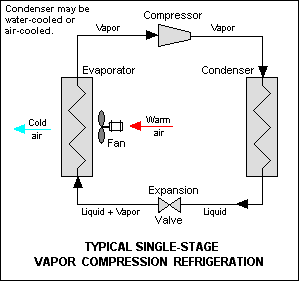 |
| Vapor compression refrigeration |
The thermodynamics of the cycle can be analyzed on a diagram as shown follow. In this cycle , a circulating refrigerant such as Freon enters the compressor as a vapor. The vapor is compressed at constant entropy and exits the compressors superheated. The superheated vapor travel through the condenser which first cools and removes the superheat and then condenses the vapor into a liquid by removing additional heat at constant pressure and temperature. The liquid refrigerant goes through the expansion valve (also called a throttle valve) where its pressure abruptly decreases , causing flash evaporation and auto-refrigeration of , typically , less than half of the liquid.
 |
| Temperature–Entropy diagram |
That results in a mixture of liquid and vapor at a lower temperature and pressure. The cold liquid-vapor mixture then travels through the evaporator coil or tubes and is completely vaporized by cooling the warm air (from the space being refrigerated) being blown by a fan across the evaporator coil or tubes. The resulting refrigerant vapor returns to the compressor to the compressor inlet to complete the thermodynamic cycle.
The above discussion is based on the ideal vapor-compression refrigeration cycle and does not take into account real-world effects like frictional pressure drop in the system , slight thermodynamic irreversibility during the compression of the refrigerant vapor or non-ideal gas behavior (if any).
Thursday, April 7, 2011
Thermodynamic Cycle
According to the second law of thermodynamics heat cannot spontaneously flow from a colder location to a hotter area ; work is required to achieve this. Work is applied to cool a living space or storage volume by pumping heat from a lower temperature heat source into a higher temperature heat sink. The operating principles of the refrigeration cycle was described mathematically by sadi carnot in 1824 as a heat engine. A heat pump can be thought of as a heat engine which is operating in reverse.
Heat pump and refrigeration cycles can be classified as vapor compression , vapor absorption , gas cycle or stirling cycle types.
Heat pump and refrigeration cycles can be classified as vapor compression , vapor absorption , gas cycle or stirling cycle types.
Thursday, March 10, 2011
Heat pump and refrigeration cycle
Thermodynamic heat pump cycles or refrigeration cycles are the models for heat pumps and refrigerators. A heat pump is a machine or device that moves heat from one location (the 'source') at a lower temperature to another location (the 'sink' or 'heat sink') at a higher temperature using mechanical work or a high-temperature heat source. Thus a heat pump may be thought of a "heater" if the objectives is to warm an area , or a "refrigerator" if the objective is to cool an area ; regardless the operating principles are identical.


Wednesday, February 2, 2011
Refrigerants
Refrigerants
A modern R-134a refrigeration compressor
"Freon" is a trade name for a family of haloalkane refrigerants manufactured by Dupont and other companies. These refrigerants were commonly used due to their superior stability and safety properties. However , these chlorine-bearing refrigerants reach the upper atmosphere when they escape. Once the refrigerant reaches the stratosphere , UV radiation from the sun cleaves the chlorine-Carbon bond , Yielding a chlorine radical. These chlorine atoms catalyze the breakdown of ozone into diatomic oxygen , depleting the ozone layer that shields the Earth's surface from strong UV radiation. Each chlorine radical remains active as a catalyst unless it binds with another chlorine radical , forming a stable molecule and breaking the chain reaction. The use of CFC as a refrigerant was once common , being used in the refrigerants R-11 and R-12. In most countries the manufacture and use of CFCs has been banned or severely restricted due to concerns about ozone depletion. In light of these environmental concerns , beginning on November 14 , 1994 , the Environmental Protection Agency has restricted the sale , possession and use of refrigerant to only licensed technicians , per rules 608 and 609 of the EPA rules and regulations; failure to comply may result in criminal and civil sanctions. Newer and more environmentally-safe refrigerants such as HCFCs (R-22, used in most homes today) and HFCs (R-134a , used in most cars) have replaced most CFC use. HCFCs in turn are being phased out under the Montreal protocol and replaced by hydrofluorocarbons (HFCs) such as R-410A , which lack chlorine. Carbon dioxide (R-744) is being rapidly adopted as a refrigerant in Europe and Japan. R-744 is an effective refrigerant with a global warming potential of 1. It must use higher compression to produce an equivalent cooling effect.
Friday, January 7, 2011
Air conditioning system basic and theories - Humidity
Humidity
Air conditioning equipment usually reduces the humidity of the air processed by the system. The relatively cold (below the dew point) evaporator coil condenses water vapor from the processed air , much as cold drink will condense water on the outside of a glass. The water is drained , removing water vapor from the cooled space and thereby lowering its relative humidity. Since humans perspire to provide natural cooling by the evaporation of perspiration from the skin , drier air (up to a point) improves the comfort provided. The comfort air conditioner is designed to create a 40% to 60% relative humidity in the occupied space. In food retail establishments , large , open chiller cabinets act as highly effective dehumidifiers.
Some air conditioning units dry the air without cooling it. These work like a normal air conditioner , except that a heat exchanger is placed between the intake and exhaust. In combination with convection fans , they achieve a similar level of comfort as an air cooler in humid tropical climates , but only consume about one-third the energy. They are also preferred by those who find the draft created by air coolers uncomfortable.
Friday, December 10, 2010
Air conditioning system basics and theories
Refrigeration cycle
A simple stylized diagram of the refrigeration cycle :
01). Condensing coil
02). Expansion valve
03). Evaporator coil
04). Compressor
Capillary expansion valve connection to evaporator inlet. Notice frost formation.
In the refrigeration cycle a heat pump transfers heat from a lower-temperature heat source onto a higher-temperature heat sink. Heat would naturally flow in the opposite direction. This is the most common type of air conditioning. A refrigerator works in much the same way , as it pumps the heat out of the interior and into the room in which it stands.
This cycle takes advantage of the way phase changes work , where latent heat is released at a constant temperature during a liquid/gas phase change and where varying the pressure of a pure substance also varies its condensation/boiling point.
The most common refrigeration cycle uses an electric motor to drive a compressor. In an automobile the compressor is driven by a belt over a pulley , the belt being driven by the engine's crankshaft (similar to the driving of the pulleys for the alternator , power steering , etc.. ). Whether in a car or building , both use electric fan motors for air circulation. Since evaporation occurs when heat is absorbed , and condensation occurs when heat is released , air conditioners use a compressor to cause pressure changes between two compartments and actively condense and pump a refrigerant around. A refrigerant is pumped into the evaporator coil , located in the compartment to be cooled , where the low pressure causes the refrigerant to evaporate into a vapor , taking heat with it. At the opposite side of the cycle is the condenser , which is located out side of the cooled compartment , where the refrigerant vapor is compressed and forced through another heat exchange coil , condensing the refrigerant into a liquid , thus rejecting the heat previously absorbed from the cooled space.
By placing the condenser (where the heat is rejected) inside a compartment and the evaporator (which absorbs heat) in the ambient environment (such as outside) or merely running a normal air conditioner's refrigerant in the opposite direction , the overall effect is the opposite , and the compartment is heated. This is usually called a heat pump and is capable of heating a home to comfortable temperatures (25°C ; 70°F) , even when the outside air is below the freezing point of water (0°C ; 32°F).
Cylinder unloaders are a method of load control used mainly in commercial air conditioning systems. On a semi-hermetic (or open) compressor , the heads can be fitted with unloaders which remove a portion of the load from the compressor so that it can run better when full cooling is not needed. Unloaders can be electrical or mechanical.
A simple stylized diagram of the refrigeration cycle :
01). Condensing coil
02). Expansion valve
03). Evaporator coil
04). Compressor
 |
| A simple stylized diagram of the refrigeration cycle: 1) condensing coil, 2) expansion valve, 3) evaporator coil, 4) compressor. |
Capillary expansion valve connection to evaporator inlet. Notice frost formation.
 |
| Capillary expansion valve connection to evaporator inlet. Notice frost formation. |
In the refrigeration cycle a heat pump transfers heat from a lower-temperature heat source onto a higher-temperature heat sink. Heat would naturally flow in the opposite direction. This is the most common type of air conditioning. A refrigerator works in much the same way , as it pumps the heat out of the interior and into the room in which it stands.
This cycle takes advantage of the way phase changes work , where latent heat is released at a constant temperature during a liquid/gas phase change and where varying the pressure of a pure substance also varies its condensation/boiling point.
The most common refrigeration cycle uses an electric motor to drive a compressor. In an automobile the compressor is driven by a belt over a pulley , the belt being driven by the engine's crankshaft (similar to the driving of the pulleys for the alternator , power steering , etc.. ). Whether in a car or building , both use electric fan motors for air circulation. Since evaporation occurs when heat is absorbed , and condensation occurs when heat is released , air conditioners use a compressor to cause pressure changes between two compartments and actively condense and pump a refrigerant around. A refrigerant is pumped into the evaporator coil , located in the compartment to be cooled , where the low pressure causes the refrigerant to evaporate into a vapor , taking heat with it. At the opposite side of the cycle is the condenser , which is located out side of the cooled compartment , where the refrigerant vapor is compressed and forced through another heat exchange coil , condensing the refrigerant into a liquid , thus rejecting the heat previously absorbed from the cooled space.
 |
| A modern R-134a refrigeration compressor |
By placing the condenser (where the heat is rejected) inside a compartment and the evaporator (which absorbs heat) in the ambient environment (such as outside) or merely running a normal air conditioner's refrigerant in the opposite direction , the overall effect is the opposite , and the compartment is heated. This is usually called a heat pump and is capable of heating a home to comfortable temperatures (25°C ; 70°F) , even when the outside air is below the freezing point of water (0°C ; 32°F).
Cylinder unloaders are a method of load control used mainly in commercial air conditioning systems. On a semi-hermetic (or open) compressor , the heads can be fitted with unloaders which remove a portion of the load from the compressor so that it can run better when full cooling is not needed. Unloaders can be electrical or mechanical.
Subscribe to:
Posts (Atom)